The Spring Cleaning Tracker That Made Me Actually Finish

Every March I tell myself this is the year I finish spring cleaning before it becomes spring avoiding. And every year, somewhere around "still haven't touched the hall closet," the list dies.
The problem wasn't motivation. It wasn't time. It was the list itself.
A checklist is a snapshot. It shows you everything you haven't done yet. And when spring cleaning involves forty-something tasks spread across six rooms over four weeks, a checklist is basically a document of your failure in progress. You cross off "wipe baseboards in kitchen" and immediately make eye contact with "deep clean oven," "declutter pantry," "scrub tile grout," and seventeen other lines. It's demoralizing before you've even put the sponge away.
Last spring I stopped using a list. I built a tracker instead — and I finished. Not just "mostly finished." Finished finished. By April 8th. I have the photographic evidence and the extremely satisfying final check-ins to prove it.
Here's exactly how I set it up.
Why Visual Tracking Actually Works (It's Not Just Aesthetic)
There's real psychology behind this — or at least, some habit formation research supports this. Studies on behavior change point to visibility and feedback loops as factors that help behaviors stick. You need to see your progress, and you need to feel it in real time. My experience matches this pretty exactly, for whatever that's worth.
A written checklist gives you feedback only in negatives — everything unchecked is a reminder of what's left. A visual tracker gives you feedback in positives. Every filled-in box, every color-coded section that shifts from empty to complete, is a tiny hit of I did that. The completed sections physically take up space on the page. You can see the momentum building.
The other thing that kills spring cleaning? Hard deadlines. "Finish by April 1st" sounds great until March 22nd when you have a work deadline and a birthday dinner and you've now "failed" before you're done. The tracker removes deadlines entirely. It tracks what's done, not what's late.
The Spread Anatomy: Room-Based, Not Task-Based
The single most important decision I made was organizing by room, not by task type.
Task-based lists look logical on paper: all the dusting in one section, all the decluttering in another, all the deep-cleaning together. The problem is that you never get the satisfaction of finishing a room. You deep-clean the kitchen but there's still kitchen tasks scattered in three other sections. Nothing feels done.
Room-based tracking changes everything. When the bedroom section is complete, the bedroom is done. That psychological closure — I finished a whole room — is what keeps momentum alive through week three when novelty has worn off.
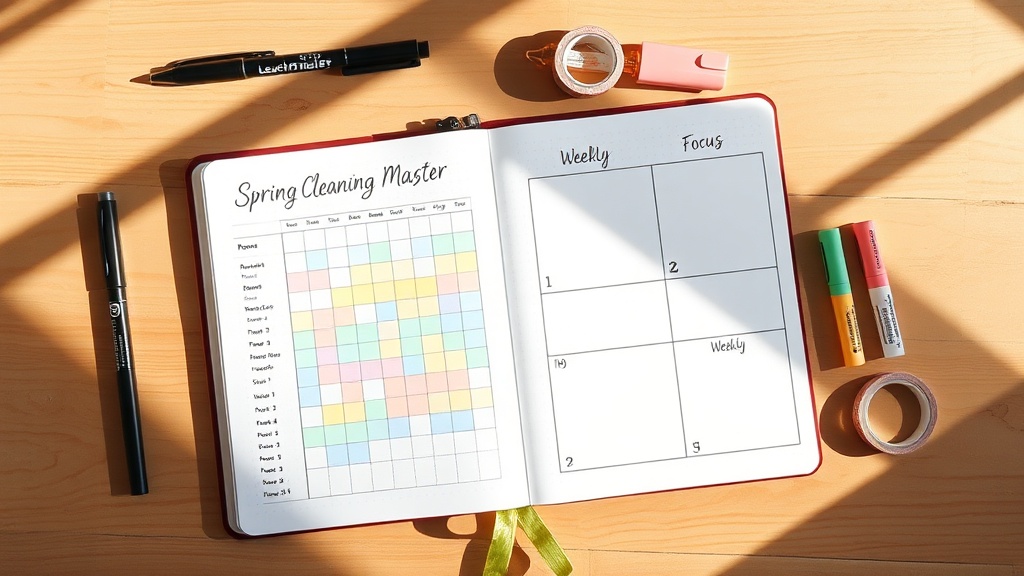
My spread uses two facing pages:
Left page — the master tracker grid. Six rooms down the left side (Bedroom, Bathroom, Kitchen, Living Room, Office Nook, Hall Closet — adjust for your space). Across the top, task columns: Declutter, Deep Clean, Organize, Wipe Down, Final Check. Each intersection gets a small box to fill in.
Right page — the weekly rhythm section. Four boxes, one per week, each with space for: which rooms I'm focusing on that week, what I actually accomplished, and a one-line "satisfaction check-in" (more on this in a minute).
No start dates. No due dates. Just rooms, tasks, and progress.
Lina's Exact Setup
Color-Coding System
Each room gets its own color. I use my Zebra Mildliner broad tip for the room header and first box fill-in, and switch to the fine tip for task lettering inside each box:
- Bedroom: Mild Rose
- Bathroom: Mild Blue
- Kitchen: Mild Yellow
- Living Room: Mild Green
- Office Nook: Mild Purple
- Hall Closet: Mild Orange (the dreaded one)
Priority level = marker weight. For tasks within each room, I use a fine-tip pen for standard tasks (wipe down shelves, vacuum) and a thick bracket mark in the room's color for high-priority deep cleans (clean behind fridge, scrub shower grout). At a glance, I can see which tasks are the heavy lifts vs. the quick wins.
The Satisfaction Marker Ritual

This is the part people ask about most when I share tracker photos.
When I finish a full room, I don't just fill in the Final Check box. I go back and draw a small star in the room's color next to the room name on the left side. Not a checkmark — a star. It sounds fussy, but there's a reason it works: it marks completion with something that looks different from the task boxes. Your eye catches it. It reads as celebration, not just record-keeping.
The ritual also slows me down for thirty seconds to actually register that I finished something. That's the feedback loop. That's the moment your brain logs "I did this and it felt good" and wants to repeat it.
Weekly Rhythm That Actually Works
I do not clean for six hours on one Saturday. I do not commit to specific days. What I do:
- Monday — Check in with the tracker. Pick two rooms to focus on this week. Write them in that week's right-page box.
- Throughout the week — Fill in boxes as I go. Sometimes that's twenty minutes before work. Sometimes it's a focused two-hour Saturday session. I follow my schedule, not a predetermined plan.
- Sunday night — Write the one-line satisfaction check-in. Doesn't have to be deep. Could be "Got the kitchen done and it looks incredible" or "Only finished one thing but the closet is DONE." The point is to close the week consciously.
Between rooms, I reset the right page with a fresh week box. The left page stays the same — it's the master record of the whole project. Watching the left page slowly fill in over the month is genuinely motivating.
Supply List
Prices verified March 2026 — stationery prices shift by retailer, so check before you buy.
Starter Setup (~$30–$35)
| Item | Brand | Approx. Cost | Budget Alternative |
|---|---|---|---|
| Dot grid notebook | Leuchtturm1917 A5 | ~$24–$27 | Exceed A5 from Target (~$6) |
| Fine-tip black pen | Staedtler Triplus Fineliner 0.3mm | ~$3–$4 per pen | Any fine ballpoint you already own |
| Mildliner set | Zebra Mildliner 5-pack (any colorway) | ~$9–$11 | Individual Mildliner singles, ~$2–$3 each |
| Washi tape (for border/decoration) | Any — this is the fun part | varies | Craft store grab-bag packs |
You do not need a new notebook if you have pages left in your current one. This spread takes two facing pages. That's it.
Premium Edition (~$55–$65)
Same as above, plus:
- Zebra Mildliner Double-Sided set (15 colors) — ~$20–$25 at most stationery shops
- Pentel Energel 0.5mm in black for crisp task writing — ~$4–$5
- A dedicated spring spread washi tape set (seasonal prints are everywhere right now — check Etsy for April-adjacent florals)
The premium version is not more functional. It's just more satisfying to look at. Worth it if that's your thing. Not worth it if you're new to this and unsure whether trackers click for you — start minimal.
The Functional Why Behind Every Decision
Because I know you're wondering.
Room grouping over task grouping — Completion by room triggers a closed loop in your brain. Crossing "kitchen" off the master tracker reads as finishing a place, not finishing a category.
No hard deadlines — Deadlines introduce shame. Shame kills momentum faster than anything. You miss a target date once and the whole project feels like a failure. Remove the date, keep the tracker, and you'll still finish. Probably faster, because you're not avoiding it.
Weekly boxes on the right page — This gives the project a rhythm without prescription. You can work fast in week one and slow in week three without the tracker judging you. It just records what happened.
The star ritual over a standard checkmark — A different mark for full completion signals to your eye that something significant happened here. It makes finished rooms visually distinct from in-progress rooms at a glance. Your brain notices the stars. It wants more stars.
Spacing for check-ins — The one-line Sunday note is the lowest-lift journaling prompt possible. It asks you to notice and name your progress once a week. That noticing is what makes the tracker feel like your project instead of a chore chart someone handed you.
The hall closet is still going to be the one you put off until week four. I'm not going to lie to you about that. But when you finally open that tracker and draw the orange star next to Hall Closet?
Genuinely one of the better feelings spring has to offer.
What room are you dreading most? Drop it in the comments — I'll design a tracker section specifically for it.