The Monthly Mood Tracker That Actually Made Me Notice My Patterns (Not Just Color Pretty Boxes)

The Monthly Mood Tracker That Actually Made Me Notice My Patterns (Not Just Color Pretty Boxes)
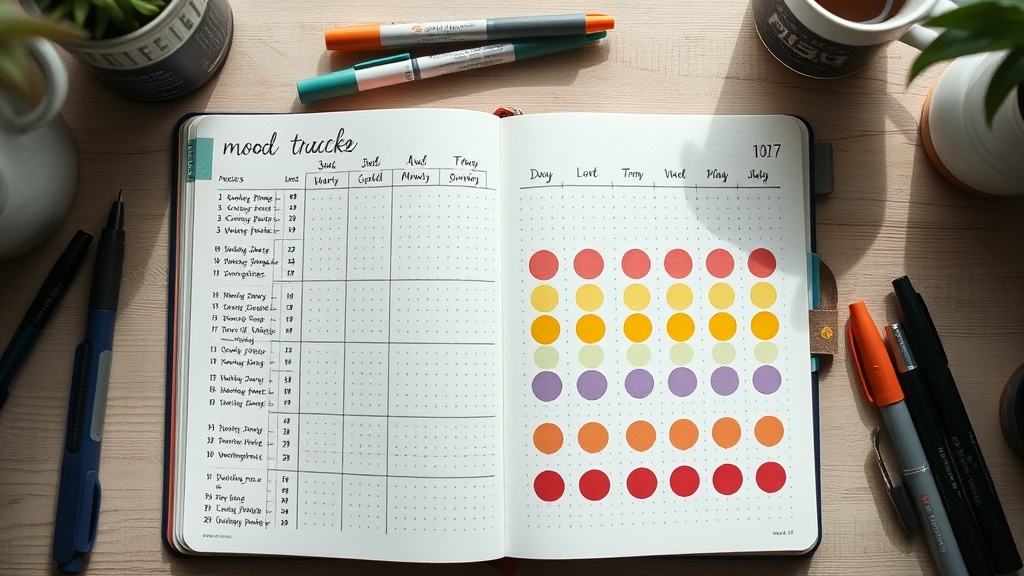
I used to think mood trackers were just a reason to use every marker in the pack. Color in a box, pick a cute legend, post it on Instagram, repeat.
And honestly? For the first six months I bullet journaled, that is exactly what mine were. Decorative filler. I never once looked back at a completed tracker and thought anything useful.
Then I changed three things about how I set mine up, and now my mood tracker is the spread I check most often — more than my habit tracker, more than my weekly, sometimes more than my to-do list.
Here is exactly how I build it and why the layout choices matter way more than the color palette.
Why Most Mood Trackers Fail (It Is Not Your Consistency)
The classic mood tracker gives you one box per day and five or six emotions to choose from: happy, sad, anxious, angry, meh, productive.
The problem? Nobody feels one emotion per day. I can be anxious at 8 AM, genuinely joyful at lunch, and irritated by 9 PM because Mr. Darcy knocked my pen cup off the desk again. Picking one color for that day is basically lying to my journal.
Strong take: a mood tracker that forces you to flatten your entire day into one feeling is not tracking your mood. It is tracking your memory bias at whatever time you fill it in.
My Three-Slot Layout
Instead of one box per day, I split each day into three time blocks:
- Morning (wake up through lunch)
- Afternoon (lunch through dinner)
- Evening (dinner through bed)
Each block gets its own small circle in a row. So each day is three circles across, and the month stacks vertically — 31 rows of three circles. It fits on one page with room for the legend on the side.
This tiny change made a massive difference. Suddenly I could see that my mornings were almost always anxious (hello, inbox dread) and my evenings were almost always calm. That pattern was invisible when I was averaging my whole day into one color.
The Legend I Actually Use
I trimmed my emotions down to seven. Not because more is bad, but because if I have to think too hard about which shade of blue means "melancholy" versus "reflective," I just skip the tracker entirely.
My current seven:
- Calm / Content — sage green
- Happy / Energized — sunflower yellow
- Anxious / Stressed — dusty lavender
- Frustrated / Irritated — burnt orange
- Sad / Low — slate blue
- Creative / In Flow — coral pink
- Tired / Drained — warm gray
I specifically chose colors I like looking at for every emotion, including the hard ones. If "anxious" is an ugly color, I subconsciously avoid marking it, and then my data is garbage.
Hot tip from two years of doing this: pair your legend colors with markers or pens you already own. Do not buy new supplies just for your tracker. Use what is in your pen cup right now and build the legend around those exact shades.
The "One Word Why" Column
This is the thing that turned my tracker from pretty art into something genuinely useful.
Next to each row of three circles, I leave a narrow column where I write one or two words about why. Not a journal entry. Not an essay. Just a tiny breadcrumb.
Examples from my February tracker:
- Feb 3: deadline crunch
- Feb 7: coffee with Sam
- Feb 12: terrible sleep
- Feb 14: solo gallery walk
- Feb 22: grocery budget stress
At the end of the month, those breadcrumbs turn the color grid into an actual story. I can see that every anxious morning that week connected to a work deadline. I can see that my creative-flow days happened after I went outside. I can see that tired days cluster around the same time every month.
Without the "why" column, the colors are just colors. With it, they are data I can act on.
My End-of-Month Review (Five Minutes, Not Fifty)
On the last day of the month, I look at the completed tracker and write three lines at the bottom of the page:
- Most common morning mood: (this month it was anxious, shocker)
- Best day and why: (Feb 14 — solo gallery walk, no phone)
- One thing to try next month: (morning walk before opening email)
That is it. Three lines. If I tried to do a full journaling session about my emotional patterns, I would never do it. Three lines I can handle even on a Sunday night when I am half asleep and just want to set up my March spreads.
Layout Tips That Keep It Functional
Use a ruler for the circles. I know, freehand is charming, but messy circles make it harder to scan the grid at a glance. A circle stencil or even a small coin works perfectly.
Put the legend on the right side, not the top. When the legend is on top, you have to keep flipping back to check it. On the right margin, it stays visible as you fill in each row.
Leave a blank row between weeks. This costs you maybe half a centimeter of space and makes weekly patterns pop visually. Trust me on this one.
Do not decorate the tracker page. I know this is heresy coming from someone with a washi tape problem, but the mood tracker works best when the colors are the decoration. Stickers and borders compete with the data. Save your deco energy for your weekly spreads.
What I Have Actually Learned From Tracking
After almost two years of doing this consistently, here is what my mood tracker has shown me that I would not have noticed otherwise:
- My anxiety is almost entirely a morning thing. By 2 PM, it has usually passed. Knowing this helps me not panic-spiral at 9 AM because I can remind myself it fades.
- Creative flow happens most on days when I do something visual before noon — sketching, rearranging my desk, even browsing Pinterest for spread ideas.
- My lowest days are almost always preceded by two or more nights of bad sleep. Not rocket science, but seeing it in color made me actually prioritize sleep.
- Socializing recharges me way more than I thought. My "introvert who needs alone time" identity took a hit when the data showed I feel best on days I saw friends.
None of this is therapy. I am not diagnosing anything. But having a visual record of how I actually feel — not how I think I feel — has changed how I plan my weeks and what I protect in my schedule.
Start Simpler Than You Think
If you have never done a mood tracker, do not start with my three-slot system. Start with one circle per day and four emotions. Do it for one month. If you actually fill it in consistently, add the time slots next month. If you skip days constantly, shrink the legend to three emotions and make the circles bigger.
The best mood tracker is the one you actually complete. Fancy layouts mean nothing if the page is half empty on March 28.
And if you are someone who already tracks moods in an app — I hear you, apps are easier. But there is something about physically coloring in a circle that makes me pause and actually check in with myself instead of just tapping a button while scrolling TikTok. The friction is the feature.
Go set up your April tracker this weekend. Keep it simple, pick colors you love, and add that "why" column. Future you is going to want that context.