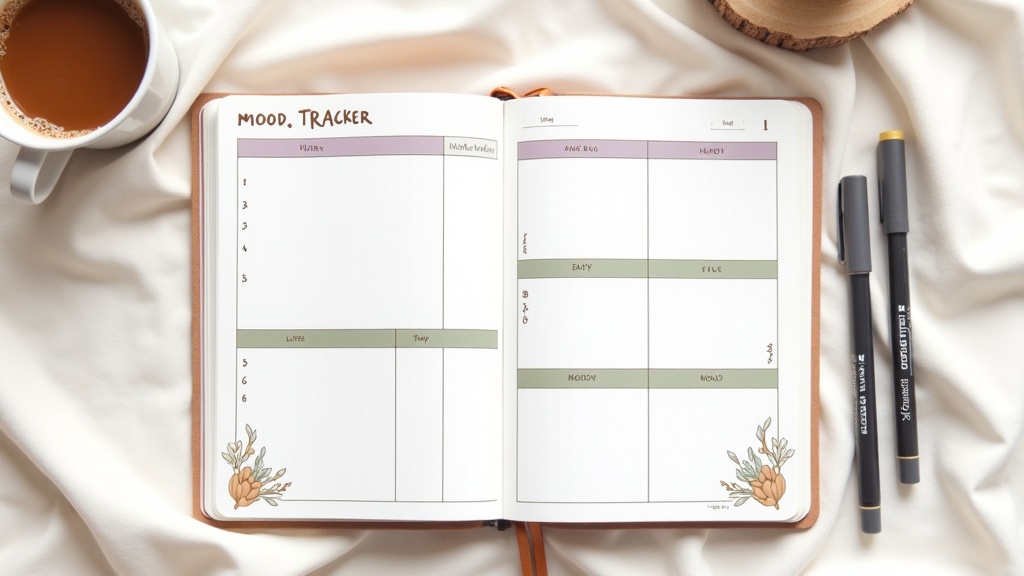
How to Set Up a Mood Tracker Spread (The One That Actually Helps You See Patterns)

Okay okay okay, we need to talk about mood trackers.
I used to think mood trackers were just pretty grids. You know the ones — gorgeous color-coded squares that look amazing but tell you... nothing. Then I changed how I set mine up, and suddenly I could actually SEE my patterns. Like, "Oh, I'm always grumpy on Mondays after late Sunday nights" or "I feel better on days I move my body." That's the magic.
This is the mood tracker that changed my relationship with my own emotional awareness. Let me show you how to make it.
Why This Layout Works
A mood tracker isn't just decoration — it's a visual emotional journal. But here's the thing: most mood trackers are TOO SIMPLE. They just track mood, which is nice, but they don't help you connect mood to CAUSES.
This layout tracks three things:
- Mood (the main data point)
- Energy level (because you can feel "good" but exhausted)
- One-word note (what influenced this mood?)
Why? Because when you look back at the month, you don't just see "I was sad a lot." You see "I was sad on days when I skipped sleep and overcommitted." That's ACTIONABLE.
What You'll Need
- Ruler (essential for the grid) — I use a 12-inch metal ruler ($8)
- Pen for the grid — Black fine-tip pen (Micron 0.3mm, $3)
- Color markers for moods — Tombow Dual Brush Pens or Zebra Mildliners ($5-8 for a set)
- Header pen — Brush pen for the title (Tombow 603 Purple, $3)
- Washi tape (optional but transforms it) — Any color you love ($3-4 per roll)
- Stickers (optional) — Small mood-related stickers ($4)
Budget version: Just use a black pen and color pencils. The grid is what matters, not the decoration. Seriously — I've seen mood trackers in plain composition notebooks that were MORE functional than the decorated ones.
Step-by-Step Setup
Step 1: Create the Grid (5 minutes)
Draw a calendar grid for the month.
- Columns: Days of the week (Mon-Sun)
- Rows: Weeks of the month
- Spacing: Make each box about 1.5" x 1.5" — big enough to color and write in
Pro tip: Use a pencil first, then trace with black pen. Erase the pencil. Looks cleaner.
Why this works: The calendar format lets you see the WEEK at a glance. You notice "Every Monday is rough" or "Weekends are consistently better." That pattern visibility is the whole point.
Step 2: Add the Header (2 minutes)
Write "February Mood" or "My Energy Map" or whatever speaks to you. Use your brush pen and make it BIG. This is the anchor of the spread.
Why this works: A clear header tells your brain "this is a tracking space." It makes the spread feel intentional, not like you just drew a random grid.
Step 3: Create Your Color Key (3 minutes)
In a corner of the spread, create a small legend:
- Lavender = Content/Good
- Sage = Okay/Neutral
- Blush = Tired/Overwhelmed
- Gold = Excited/Energized
Important: Use colors that FEEL right to you. Don't copy mine. Does "happy" feel yellow to you? Use yellow. Does "overwhelmed" feel red? Use red. Your color associations are personal and that's the point.
Why this works: The color key means you don't have to write "good" in every box. You just color it. Faster to track, which means you'll actually DO it.
Step 4: Add the "Note" Column (2 minutes)
On the right side of your grid, create a narrow column. This is where you write ONE WORD about what influenced your mood that day.
Examples:
- "Slept well"
- "Deadline stress"
- "Moved my body"
- "Skipped coffee"
- "Good conversation"
- "Alone time"
Why this works: This is where the MAGIC happens. When you look back at the month and see "Slept well" appears on all your good days, you've just discovered something important about yourself. No therapy required — just data.
Step 5: Optional Decoration (5-10 minutes)
If you want to make it pretty:
- Washi tape border — One strip on the left or top. Not overwhelming.
- Small stickers — One per week or one per mood color. Minimal.
- Doodle accents — Small flowers or stars in empty corners.
IMPORTANT: Decoration is LAST. Function first, beauty second. If you run out of time, skip the stickers. The tracker works without them.
How to Use It Daily
Every evening (or morning, your choice), spend 30 seconds:
- Color the day's box with your mood color
- Write one word about what influenced it
- Done.
That's it. No journaling required. No guilt if you miss a day. Just data.
What to Look For When Reviewing
At the end of the month, spend 5 minutes looking at your tracker:
- Pattern in colors: Are certain days of the week consistently one color? (Mondays rough? Fridays energized?)
- Pattern in notes: Do you feel better on days you moved your body? Slept more? Had alone time?
- Surprise patterns: "Oh, I thought I was always stressed, but I'm actually mostly content."
Why this matters: This is how you actually change things. Not through willpower or motivation. Through DATA. "I feel better when I sleep 8 hours" is more powerful than any productivity hack.
Customization Options
If you're minimal: Just the grid and colors. No notes, no decoration. Still works.
If you're tracking more: Add columns for sleep hours, water intake, exercise. Make it YOUR data.
If you want to go deep: Add a second page with monthly reflections. "What I learned about myself this month..."
If you're digital: Use a spreadsheet with conditional formatting (colors change based on mood value). Same concept, different medium.
Supplies Used
Featured supplies:
- Tombow Dual Brush Pen Set ($12 for 10 colors) — "The gold standard for planner headers"
- Zebra Mildliner Set ($8 for 5 colors) — "Perfect for coloring grid boxes without bleeding"
- Micron Black Pen 0.3mm ($3) — "For the grid lines that don't smudge"
- Metal Ruler 12" ($8) — "Straight lines every time"
- Washi Tape (Michael's, $3-4 per roll) — "Dusty Lavender + Sage Green set"
Budget alternatives:
- Instead of Tombow: Use any brush pen you own, or even a regular marker
- Instead of Zebra Mildliners: Use colored pencils (Prismacolor or even basic Crayola)
- Instead of Micron: Use any black pen you have at home
- Instead of metal ruler: Use the edge of a book or notebook (less precise but works)
- Skip the washi tape: The tracker works perfectly without it
Real talk: I've seen mood trackers in $3 composition notebooks with just a black pen that were MORE useful than expensive decorated ones. The grid is the tool. The colors help. The decoration is the cherry on top. Don't let supply cost stop you from tracking.
The Real Magic
Mood trackers aren't about having a pretty planner. They're about knowing yourself better. And that knowledge? That's worth 30 seconds a day.
I promise you'll notice something by week two. Something about when you feel good, what makes you tired, when you need to slow down. That's the whole point.
Show Me Yours!
What mood tracker setup do you use? Are you a color-coded minimalist or an elaborate note-taker? Tag us @artsyagenda or comment below — I love seeing how different people track their emotional lives. Your patterns are unique and I want to see them.
And remember: Your mood tracker doesn't have to be perfect. It just has to be honest.