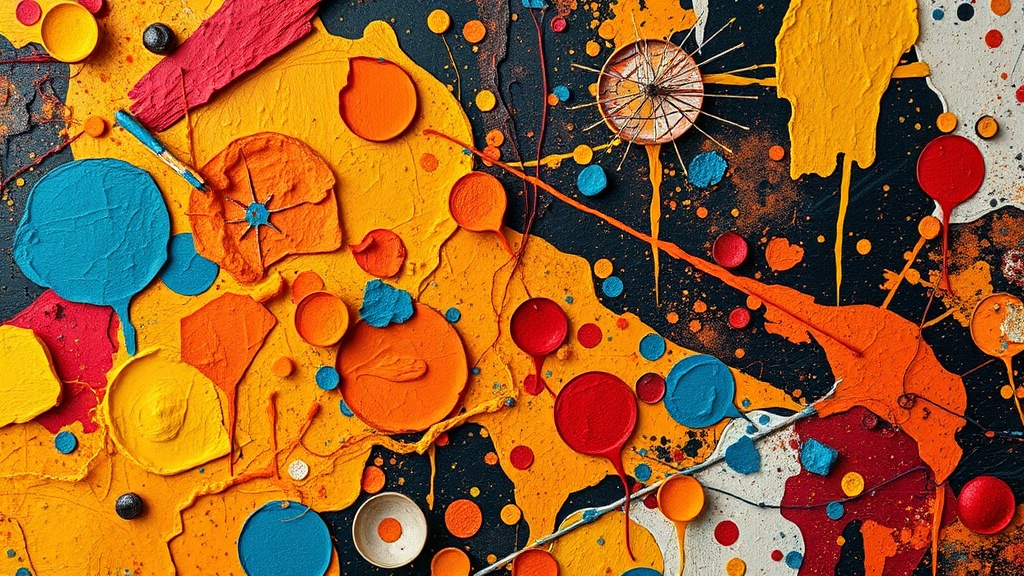
How to Create Stunning Textured Abstract Art with Everyday Household Items

This post covers practical, hands-on methods for building dimensional abstract paintings using objects already found around the house—think spatula marks from old takeout chopsticks, pebbled impressions from bubble wrap, and ridged patterns torn from cardboard edges. You'll learn how to select the right items for specific effects, layer acrylic paints without creating muddy colors, and finish pieces so they withstand dust, sunlight, and time. The goal is straightforward: to prove that stunning texture doesn't require a trip to the art supply store or a studio budget that rivals a monthly rent payment. With a little organization and the right sequence, anyone can turn household clutter into gallery-worthy surface interest.
Can You Make Textured Abstract Art Without Buying Expensive Supplies?
Yes—textured abstract art can be built almost entirely from items already sitting in kitchen drawers, garage shelves, bathroom cabinets, and recycling bins.
The commercial art world loves selling the idea that professional texture comes only from imported molding paste and palette knives forged in Milan. Here's the thing: texture is simply physical variation on a surface. A plastic fork from a takeout container leaves grooves nearly identical to those made by a $12 metal comb tool. An expired credit card spreads gesso with the same crisp authority as a Liquitex Basics Toning Knife. The difference isn't the price tag—it's the intention behind the mark and the patience with which it's applied.
That said, not every household object behaves like a traditional art supply. Natural sponges absorb too much paint unevenly. Cotton balls shed fibers into wet acrylics. The catch? Match the object's physical personality to the effect you want. Rough, porous items create broken, speckled texture that feels earthy and raw. Smooth, hard objects leave clean, graphic lines with modern precision. Flexible materials—like balloons or rubber gloves—can be pressed into paint to create rounded, biomorphic shapes. Experimentation beats expensive equipment every single time.
What Everyday Objects Create the Best Paint Textures?
The best household texture-makers fall into four distinct categories—kitchen tools, paper and packaging, hardware scraps, and personal care items—each producing marks ranging from fine stippling to heavy impasto.
| Household Item | Texture Effect | Best Used With |
|---|---|---|
| Bubble wrap | Uniform dots, cellular patterns | Heavy body acrylics or diluted white gesso |
| Plastic fork / comb | Parallel grooves, rake marks | Thick paint dragged across wet layers |
| Old credit card | Sharp ridges, scraping back, hard edges | Golden Heavy Body Acrylics |
| Crumpled aluminum foil | Random metallic imprints | Thin washes or glazing mediums |
| String or rubber bands | Wavy linear striations | Under-painting and pull-away techniques |
| Cardboard edges | Hard striped ridges | All acrylic consistencies |
| Silicone basting brush | Feathery broken strokes | Thinned acrylics or ink washes |
The Non-Negotiable Basics
- A sturdy substrate—Canson XL Mix Media pads or recycled cardboard work perfectly for practice pieces.
- Heavy body acrylics—Golden Heavy Body Acrylics in titanium white, raw umber, and one accent color.
- A flat work surface covered in newspaper or a Dollar Tree plastic tablecloth.
- Water and paper towels for quick tool cleaning between layers.
Kitchen utensils deserve special attention because they're designed to interact with viscous materials. A silicone basting brush—like those from OXO Good Grips—creates feathery strokes when loaded with thinned paint. A metal whisk pressed into wet gesso leaves deep indentations that catch light beautifully. A crumpled Bounty paper towel can blot away excess pigment, revealing ghostly underlayers much like cheesecloth in oil painting.
Paper and packaging offer some of the most predictable and controllable textures. Corrugated cardboard from Amazon boxes produces crisp, parallel lines when dragged across the surface. Bubble wrap stamps perfect hemispheres—ideal for repetitive rhythm across a large canvas. Saran Wrap pressed into wet paint and peeled away after twenty minutes leaves wrinkled valleys like weathered stone.
Hardware scraps shouldn't be ignored, especially for artists who prefer an industrial aesthetic. Coarse sandpaper dragged across a semi-dry layer creates soft, diffused edges suggesting age and erosion. A plastic drywall spreader (often languishing in garage buckets) lays down broad ridges fast. Worth noting: wash these thoroughly—acrylics won't stick to sawdust or motor oil.
How Do You Organize a "Found Object" Palette?
Treat the collection of household tools like a bullet journal spread—grouped by function, labeled by effect, and arranged within arm's reach before the first brushstroke hits the canvas.
Lina's approach (and one that saves endless frustration) is to gather ten to fifteen objects, test each one on a scrap piece of Canson XL Mix Media paper, and write the result directly on the paper edge with a Sharpie. "Fork = vertical grooves." "Foil = chaotic dimples." "Cardboard = stripes." This creates a visual reference library that eliminates mid-painting guesswork. It's the planning-as-art mentality in action—organized, intentional, and deeply satisfying.
How Do You Build Layers Without Making Mud?
The secret is letting each layer dry completely before adding the next, and restricting the working palette to three or four colors maximum.
Abstract texture fails most often because artists pile wet paint on wet paint in a rush of creative excitement. The result isn't layering—it's a murky stew where every color collapses into gray-brown anonymity. Acrylics dry quickly to the touch, but that doesn't mean they're ready for another coat in fifteen minutes. Thick Liquitex Professional Gesso can take two hours to cure. Heavy Golden Heavy Body Acrylics might need overnight drying in humid climates. Rushing collapses distinct textures into one lump and traps moisture that leads to cracking.
Color discipline matters just as much as timing. Limit the palette to analogous colors—burnt sienna, raw umber, and titanium white—or a single hue plus black and white. That said, one small complementary accent—a pop of cadmium yellow against deep violet—creates tension without chromatic chaos. The fewer colors fighting for attention, the more the physical texture itself becomes the star of the composition.
Here's the thing about building real dimension: contrast isn't just about light and dark. It's about smooth against rough, glossy against matte, thick against thin, warm against cool. Start with a thin wash to establish mood. Let it dry—completely. Add a mid-weight texture layer using cardboard, string, or a comb dragged through wet medium. Let it dry. Finish with selective highlights of thick paint applied with a plastic knife or old hotel key card. Each stage should be touch-dry before the next begins. Think of it as a project timeline: Phase One (wash), Phase Two (texture), Phase Three (detail). No skipping steps.
What's the Best Way to Seal and Display Textured Artwork?
Once the painting is fully cured, apply a clear acrylic varnish—either brush-on or spray—to lock in the texture and protect the surface against dust, UV light, and fingerprints.
Textured pieces collect dust like magnets. Those ridges and valleys catch light beautifully, but also collect pet hair, grease, and dust. A proper sealant creates a protective barrier without flattening the dimension. Golden's Polymer Varnish comes in gloss, satin, and matte finishes, and it's formulated specifically for acrylic textures. For large pieces, Krylon Crystal Clear Acrylic Coating works well—spray in thin, even passes to avoid drips in crevices.
Before sealing, make sure the painting has cured for at least 72 hours. Acrylics feel dry long before they're fully set. Applying varnish too early traps moisture, leading to clouding or a sticky surface that attracts dust. The catch? Once varnished, the piece is significantly harder to rework. Step back, live with it for a day, and only commit when the composition is finished.
Displaying textured work requires a little extra thought. Deeply textured pieces don't always play nicely behind glass—the raised surface can press against the frame, creating shadow lines. Instead, mount the canvas in a floating frame (the raw wood ones from Blick Art Materials work beautifully) or hang it gallery-style with Command Picture Hanging Strips for a clean, modern look. If the piece is on paper, adhere it to a cradled wood panel with Mod Podge Matte before sealing. This prevents warping and gives the work a substantial, professional presence that feels intentional rather than improvised.
"Texture is the vocabulary of the surface. Without it, paint is just color."
For those interested in how texture became a language of its own within modern art, MoMA's overview of Abstract Expressionism offers excellent insight into how artists built physical surfaces that became content itself.
Textured abstract art isn't about owning the right tools or mastering expensive techniques. It's about seeing possibility in the ordinary—the grid of an egg carton, the spiral of a notebook wire, the teeth of a disposable comb. Gather what's already within reach. Lay down a layer. Let it dry. Repeat. The result won't just decorate a wall; it'll carry the quiet, organized story of everyday objects transformed into something worth looking at twice.