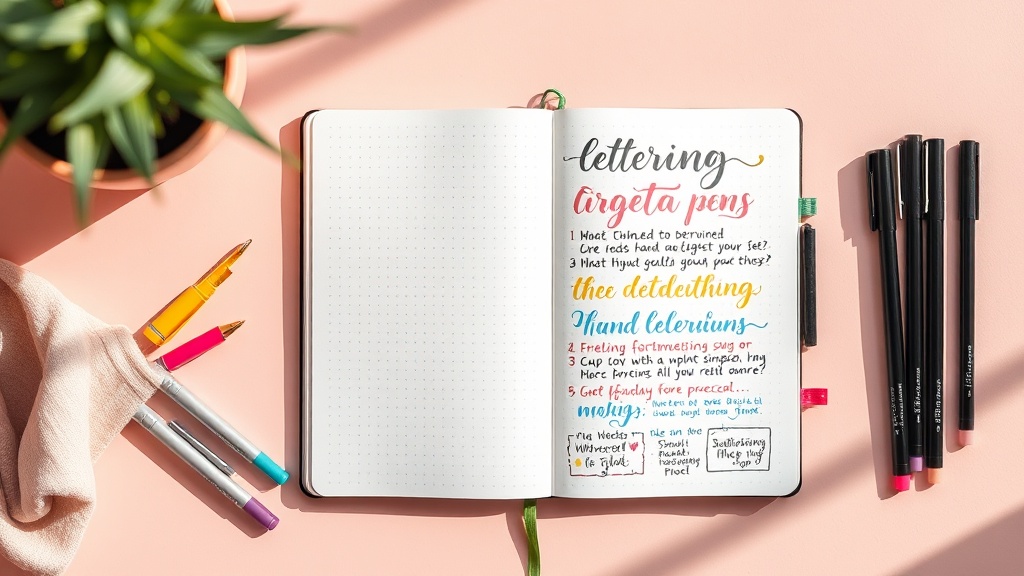
Budget-Friendly Lettering Supplies That Still Look Gorgeous

Ever feel like gorgeous lettering requires a pricey pen collection? I’ve been there — staring at my bullet journal, dreaming of flawless calligraphy, but my wallet keeps whispering, “Maybe next month.”
What affordable lettering tools actually work for bullet journals?
I’ve spent the last few weeks testing a range of pens, from boutique Japanese brands to discount‑aisle finds. Below is the lineup that survived my rigorous spread‑testing process.
1. Which budget fineliner gives me crisp, ghost‑free lines?
Sharpie Pen (Fine Point) — The unsung hero of the stationery aisle. It writes with a smooth, slightly bold line that stays crisp on 80 gsm Leuchtturm paper. No ghosting, no bleed‑through. I grabbed a 12‑pack for under $8, and it’s perfect for habit‑tracker grids and fine borders.
2. Can I get a brush‑pen feel without the price tag?
Crayola Super Tips (Fine Tip) — These are the budget‑friendly answer to Tombow Dual Brush Pens. The tip flexes enough for thin strokes and thicker flourishes, and the water‑based ink dries quickly. I love using them for hand‑lettered headers; the colors are vivid, and a 6‑pack runs around $6.
3. What about a true archival ink pen that won’t fade?
Sakura Pigma Micron (01) — Yes, it’s a bit pricier ($3 per pen), but you only need a few. The archival, waterproof ink means you can layer with highlighters later without smudging. It’s the go‑to for permanent lettering that lasts.
4. Any decent gel‑ink pen for quick notes?
Muji Gel Ink (0.38 mm) — While the ink sits a tad wet for heavy borders, it’s perfect for jotting quick captions or dates. It’s ultra‑smooth and costs just $1 per pen. Use it where precision isn’t critical.
How can I mix and match these supplies without over‑complicating my kit?
My rule of three keeps the bag light and the mind clear: one fine‑line fineliner (Sharpie), one brush‑pen alternative (Crayola Super Tips), and one archival pen (Micron). Add a gel‑ink pen for occasional notes, and you’ve covered every use‑case.
Sample spread setup
- Use Sharpie for habit‑tracker grids — the bold line makes each box pop.
- Apply Crayola Super Tips for hand‑lettered day‑of‑the‑week headers — the flexible tip lets you vary stroke width for a dynamic look.
- Reserve Micron for any permanent notes or quotes you want to keep forever.
- Grab the Muji for quick captions or date stamps.
Where can I find these pens for the best price?
Here’s a quick cheat‑sheet of where I snagged each item:
- Target — Sharpie Fine Point (12‑pack) — $7.99
- Amazon — Crayola Super Tips — $5.49
- JetPens — Sakura Micron 01 — $12.00
- Muji — Gel Ink Pen 0.38 mm — $1.50 each
What’s the concrete takeaway for my fellow planners?
Start with the three‑pen rule, test each on your favorite paper, and watch your spreads look professional without a $100 pen budget. By the end of the week, you’ll have a reliable toolkit that supports both crisp grids and expressive lettering.
Pro tip: Keep a small “pen‑swap” notebook where you record which pen you used for each spread element. Over time you’ll see patterns — maybe you love the Sharpie for mood‑trackers but prefer the Micron for quotes. That data becomes your personal supply guide.
Happy lettering, and may your spreads stay beautiful AND affordable!
For more pen deep‑dives, check out my Ultimate Black Fineliner Showdown, the Pen Test of 12 Fineliners, and the Only 3 Pens You Need posts.
Steps
- 1
Choose your core three pens
- 2
Test each on a sample page
- 3
Record results and settle on the best fit